As Venture capital vs private equity takes center stage, this opening passage beckons readers with casual formal language style into a world crafted with good knowledge, ensuring a reading experience that is both absorbing and distinctly original.
Venture capital and private equity are both vital components of the finance industry, each with its unique characteristics and strategies that drive investments and shape the business landscape. Understanding the differences between these two forms of investment can provide valuable insights for investors, entrepreneurs, and industry enthusiasts alike. Let’s delve into the nuances of venture capital and private equity to unravel their distinct features and explore the intriguing world of investment opportunities they offer.
Venture Capital vs. Private Equity Overview
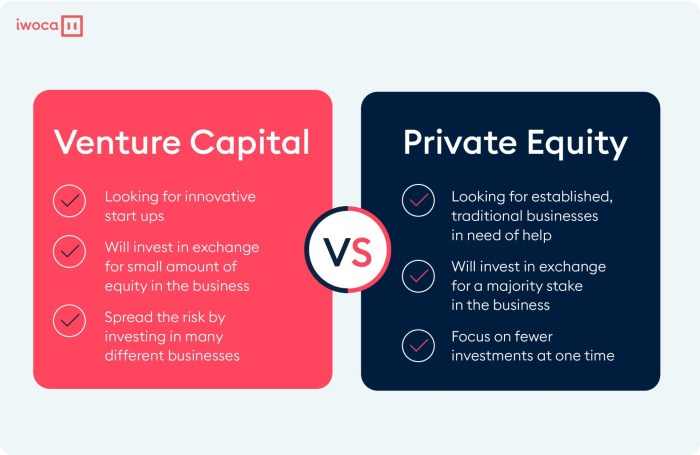
Venture capital and private equity are both forms of investment that involve providing capital to companies in exchange for a stake in the business. However, there are key differences between the two.Venture capital typically involves investing in early-stage companies with high growth potential. These firms are often startups looking to develop a new product or enter a new market. Venture capitalists provide funding in exchange for equity and take an active role in guiding the company towards success.Private equity, on the other hand, focuses on investing in more established companies that are seeking to expand, restructure, or improve their operations.
Private equity firms usually acquire a majority stake in the company and work towards increasing its value over a period of time before exiting the investment.
Main Differences between Venture Capital and Private Equity
- Venture capital targets early-stage companies with high growth potential, while private equity invests in more mature companies.
- Venture capitalists take an active role in the management of the company, while private equity firms focus on improving the operations and financial performance of the business.
- Venture capital investments are typically higher risk but offer the potential for high returns, while private equity investments are more conservative and aim for steady, long-term growth.
Typical Investment Stages Targeted by Venture Capital and Private Equity Firms
- Venture Capital:
- Seed Stage: Providing funding to help the company develop its product or service.
- Early Stage: Investing in companies that have a proven business model but are looking to scale up.
- Growth Stage: Supporting companies that are expanding rapidly and need capital to fuel their growth.
- Private Equity:
- Buyout: Acquiring a controlling stake in a mature company to drive operational improvements and increase value.
- Expansion: Providing capital to support a company’s growth initiatives, such as entering new markets or launching new products.
- Turnaround: Investing in distressed companies to restructure and revive their operations.
Venture Capital Investment Strategy
Venture capital firms have a specific investment strategy focused on funding early-stage startups with high growth potential. These firms provide capital to startups in exchange for equity ownership, taking on higher risk in hopes of achieving substantial returns.
Primary Investment Focus Areas
- Technology: Venture capital firms often invest in technology startups, including software, hardware, and internet-based companies.
- Healthcare: Firms may also focus on healthcare startups, including biotech, medical devices, and digital health companies.
- Consumer Goods: Some venture capital firms invest in consumer goods startups, such as food and beverage, fashion, and lifestyle brands.
Risk Tolerance and Return Expectations
Venture capital investors have a high risk tolerance due to the early-stage nature of their investments. They understand that many startups may fail, but they are willing to take that risk for the potential of significant returns. These returns are expected to be multiples of the initial investment, often aiming for 10x or more.
Typical Exit Strategies
- Initial Public Offering (IPO): One common exit strategy for venture capital investors is to take a startup public through an IPO, allowing them to sell their shares on the public market.
- Acquisition: Another exit strategy is for the startup to be acquired by a larger company, providing investors with a return on their investment through the acquisition price.
- Secondary Market Sale: In some cases, venture capital investors may sell their shares to other investors in the secondary market before the company goes public or gets acquired.
Private Equity Investment Strategy
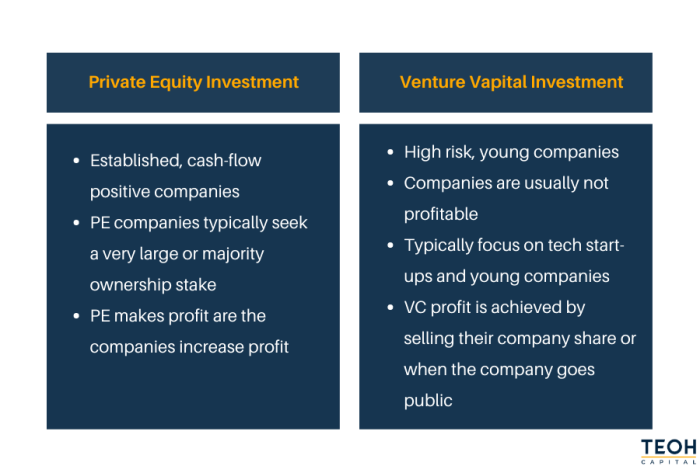
Private equity investments are characterized by a focus on acquiring equity stakes in private companies or taking public companies private. These investments are typically made with the goal of improving the company’s performance and ultimately generating a return on investment.
Types of Companies Targeted by Private Equity Firms
Private equity firms often target mature companies with strong growth potential, distressed companies in need of restructuring, or companies looking to expand through acquisitions. These companies are usually not publicly traded and may benefit from the operational expertise and resources that private equity investors can provide.
- Mature Companies with Growth Potential: Private equity firms may invest in established companies that have the potential for significant growth but require additional capital and strategic guidance to reach their full potential.
- Distressed Companies: Private equity firms may also target companies facing financial challenges or operational difficulties, with the goal of turning them around and improving their performance.
- Companies Looking to Expand: Private equity investors may partner with companies seeking to grow through acquisitions or other strategic initiatives, providing the necessary capital and expertise to support their expansion plans.
Typical Holding Period and Exit Strategies in Private Equity Deals
Private equity investments are usually long-term in nature, with a typical holding period ranging from three to seven years. During this time, private equity firms work closely with the company’s management to implement operational improvements and strategic initiatives that will increase the company’s value.
Exit strategies in private equity deals often involve selling the company to another investor, taking the company public through an initial public offering (IPO), or conducting a secondary buyout.
Fund Structures and Capital Deployment
Fund structures and capital deployment are essential aspects of both venture capital and private equity firms. Let’s delve into the differences between the two and how they deploy capital into investments.
Fund Structures Comparison
- Venture Capital: Venture capital firms typically raise funds from institutional investors, high-net-worth individuals, and corporations to create a venture capital fund. These funds are then used to invest in early-stage, high-growth potential startups.
- Private Equity: Private equity firms raise funds through limited partners (LPs), which can include pension funds, endowments, and wealthy individuals. These funds are utilized to acquire established companies with the goal of improving operations and ultimately selling for a profit.
Capital Deployment Process
- Venture Capital: Venture capital firms deploy capital by providing funding to startups in exchange for equity ownership. They often take an active role in guiding the growth of the company and aim for a successful exit through an IPO or acquisition.
- Private Equity: Private equity firms deploy capital by acquiring a controlling stake in a company, often through leveraged buyouts. They work closely with management to implement operational improvements and strategic initiatives to increase the company’s value before eventually exiting through a sale or IPO.
Role of Limited Partners (LPs)
- Limited partners play a crucial role in both venture capital and private equity funds by providing the capital needed for investments. LPs are passive investors who entrust the fund managers to make investment decisions on their behalf.
- LPs receive returns on their investments based on the performance of the fund and the success of the investments made by the venture capital or private equity firm. They typically receive a share of the profits earned from successful exits.
In conclusion, the comparison between venture capital and private equity reveals the diverse approaches and investment strategies adopted by these financial entities. While venture capital focuses on nurturing early-stage startups and high-growth companies, private equity delves into mature businesses with the aim of restructuring and enhancing operational efficiency. By grasping the fundamentals of these investment avenues, stakeholders can make informed decisions and navigate the dynamic landscape of finance with confidence and acumen.
FAQ Section
What distinguishes venture capital from private equity?
Venture capital typically invests in early-stage companies with high growth potential, while private equity focuses on mature businesses with opportunities for restructuring and growth.
What are the key differences in investment focus between venture capital and private equity?
Venture capital firms concentrate on nurturing startups and innovative ventures, whereas private equity firms target established companies seeking operational improvements and growth.
How do exit strategies differ for venture capital and private equity investments?
Venture capital investors often exit through IPOs or acquisitions, while private equity investors may opt for selling to another company, management buyouts, or recapitalization.


